AI is no longer a buzzword bolted onto trading platforms for marketing purposes — it’s quietly running inside the scanners, backtesters, and execution engines that millions of retail traders already use. Market predictions for AI-based trading systems point to continued fast growth: the AI trading platform market grew from roughly $11 billion in 2024 to an estimated $16 billion in 2026, according to Grand View Research, and it’s projected to keep climbing through the decade. But the same momentum that’s driven real innovation has also fueled a flood of “guaranteed returns” claims, unregistered bots, and vague passive-income promises.
This guide walks through what AI trading actually is, how it works, which AI trading tools and AI investment apps are worth a look, and — just as important — where the real risks sit. No guaranteed-return claims here, no push toward a specific broker. Just a straight look at what AI for trading can and can’t do in 2026.
1. What Is AI for Trading?
At its simplest, AI trading means using artificial intelligence — usually machine learning, deep learning, or reinforcement learning — to analyze markets, generate trade signals, or execute trades automatically. Instead of a person staring at charts all day, a model trained on historical and live data does the pattern-spotting, and in many cases the execution too.
The term covers a wide range of setups. On one end are simple AI-powered scanners that just flag opportunities for a human to act on. On the other are fully autonomous systems — sometimes called agentic AI trading — that research, decide, and execute with little to no human input. Most of what people actually mean by “AI trading tools” sits somewhere in between: some blend of AI-generated signals and automated or semi-automated execution.
One thing worth flagging upfront: a genuinely useful AI trading system should be able to explain, at least at a high level, why it made a particular call. Explainable AI in trading isn’t just enterprise jargon — for a retail trader, it’s the difference between understanding your own risk exposure and just hoping for the best.
AI for Trading vs. Algorithmic Trading vs. Quant Trading
These three terms get used interchangeably online, and that’s a genuinely common point of confusion for people newer to the space. They’re related, but distinct:
| Quant Trading | Algorithmic Trading | AI Trading | |
|---|---|---|---|
| What it is | Researching and building strategies with math and statistics | Executing trades automatically based on pre-set rules | Using ML/DL/RL models that learn patterns directly from data |
| Best described as | The “thinking” phase | The “doing” phase | A more adaptive, less predictable layer on top of either |
| Predictability | N/A — research, not execution | Deterministic: same input, same output | Can shift as the model retrains or conditions change |
In practice, algorithmic trading is often treated as a subset of quantitative trading — quants build the model, algorithms execute it. AI trading is the newer, more fluid layer on top: it can help generate the strategy, optimize the execution, or both, and because it learns from data rather than following fixed rules, its behavior is inherently harder to predict than a straightforward rules-based algorithm. In 2026, the lines are blurring fast, as AI gets used to both build quant models and drive algorithmic execution.
2. How AI for Trading Works
Strip away the marketing and most AI trading systems break down into three stages.

Data Collection & Signal Processing
Everything starts with data — price history, order book depth, news sentiment, sometimes alternative data like social chatter or macroeconomic releases. The system processes this into a form a model can actually use.
Prediction Models — ML, Deep Learning, Reinforcement Learning & Generative AI
This is where “how AI is used in different steps of trading” really shows up. Machine learning for trading typically means models trained to spot statistical patterns and correlations. Deep learning adds layers of abstraction for more complex, non-linear relationships. Reinforcement learning in trading works differently — the model learns through trial and error, getting “rewarded” for profitable decisions in a simulated environment before it ever touches real capital. Generative AI trading is the newest layer, and it’s less about prediction and more about synthesis: summarizing earnings calls, drafting research notes, running scenario analysis. How generative AI is revolutionizing trading has as much to do with research speed as it does with signal generation.
Execution & Risk Management
Once a signal exists, execution logic decides how — and whether — to act on it: position sizing, stop-losses, slippage controls. Systems worth using bake risk management into this stage rather than treating it as an afterthought.
3. Types of AI Trading Tools & Bots
“AI trading bots” and “AI trading tools” get used as catch-alls, but they cover meaningfully different products — from simple alert systems to fully automated trading strategies that need no daily input at all. How to choose the right AI trading tool for your trading style really comes down to one question: how much of the actual decision-making do you want to hand over?
Signal & Scanning Tools vs. Fully Automated Bots
Some AI trading platforms only surface opportunities — AI stock scanning tools like Trade Ideas’ Holly AI comb through thousands of tickers and flag setups, but a human still pulls the trigger. Others are fully automated bots that execute without any manual step once switched on. Knowing which one you’re actually signing up for matters more than most product pages make clear.
Free AI Trading Tools — What You Actually Get
Free AI trading tools and free AI trading bots exist, but “free” usually means a limited version: fewer signals, delayed data, capped backtests, or a scanner with no execution layer attached. They’re a reasonable way to test whether AI-assisted trading fits how you actually trade before paying for anything — just don’t expect a free tier to match a paid platform’s depth.
No-Code AI Trading Platforms
This is one of the fastest-growing corners of the space. No-code AI trading platforms let you build and test a strategy visually — drag-and-drop logic, sometimes even plain-English prompts — without writing a line of code. Composer, for instance, lets you build automated strategies for stocks and ETFs through a visual interface, and TrendSpider does something similar for chart-pattern-based strategies. For a more do-it-yourself stack, pairing a broker API like Alpaca with an automation tool like Zapier can get a basic rules-based bot running with no formal programming background at all.
(A full side-by-side of specific platforms — pricing, supported markets, backtesting depth — is really its own piece. This section is meant to orient you, not replace that research.)
4. AI Trading by Asset Class
AI trading tools aren’t one-size-fits-all across markets, even when a platform’s marketing suggests otherwise.
AI Trading for Stocks
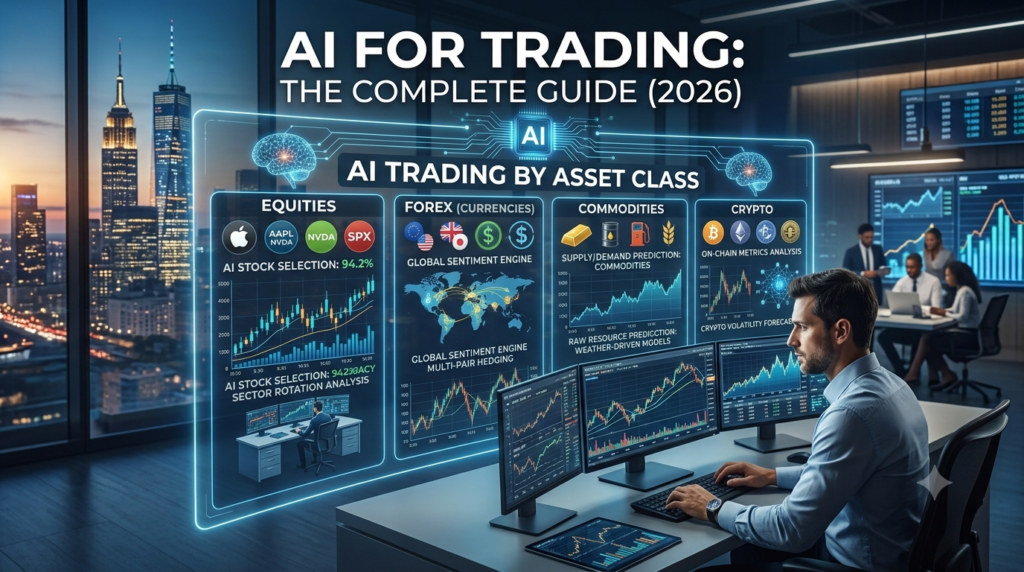
AI stock trading tools tend to lean on scanning and pattern recognition — flagging technical setups, unusual volume, or sentiment shifts across thousands of tickers — since equities markets have the deepest historical datasets to train on.
AI Trading for Crypto
AI crypto trading tools usually emphasize round-the-clock automation, since crypto markets never close. Grid bots, DCA (dollar-cost-averaging) bots, and arbitrage bots are especially common here, partly because crypto’s volatility creates more short-term pattern opportunities than slower-moving traditional markets.
AI Trading for Forex
AI forex trading tools typically lean on macro and sentiment signals — interest rate expectations, economic releases, cross-currency correlations — since currency moves are driven more by macroeconomic events than by any single company’s fundamentals.
Most platforms actually support more than one of these — stocks, crypto, forex, and sometimes commodities — from a single dashboard. It’s worth checking whether the underlying model was genuinely trained and tuned for the asset class you care about, rather than just bolted on as an extra market.
5. Does AI Trading Actually Work? Is It Profitable?
So which AI trading tools actually work? The honest answer is: it depends heavily on the strategy, market conditions, and cost structure — not on which platform has the flashiest AI branding. This is the question most guides gloss over, and it’s worth sitting with.
What “Profitable” Actually Means After Fees, Spread & Slippage
A backtest with a beautiful equity curve means very little once you factor in trading fees, bid-ask spread, and slippage — the gap between the price a strategy expects and the price it actually gets filled at. A strategy that looks profitable on paper can turn marginal, or even lose money, once real-world costs are subtracted. Can you make money with AI trading bots? Sometimes — but “sometimes, after costs, with the right strategy and market conditions” is a very different claim from “guaranteed profits.”
Backtested vs. Live Performance — Why Results Diverge
This is arguably the biggest gap between marketing and reality in AI trading. A model can end up fit to the noise in historical data rather than a genuine, repeatable edge — a problem generally known as overfitting. When that happens, a strategy performs beautifully in a backtest and falls apart the moment it hits live markets, partly because conditions shift (often called model drift) and partly because the “edge” was never real to begin with.
Avoiding Overfitting When Backtesting a Strategy
A few practical guardrails: test on out-of-sample data the model never saw during training, favor simpler models with fewer tunable parameters over needlessly complex ones, and treat a suspiciously smooth backtest curve as a reason for suspicion rather than confidence.
6. Red Flags: How to Evaluate an AI Trading Tool
This is the section most competing guides skip entirely, which is exactly why it matters.
Guaranteed-Return Promises & Common Scam Signals
If a platform promises guaranteed profits, or claims its AI simply can’t lose, that’s not confidence — it’s a scam signal. A joint investor alert from the SEC, FINRA, and NASAA specifically warns that fraudsters exploit AI’s popularity with claims of guaranteed stock-picking success or trading systems that supposedly can’t lose, and that promises of high, guaranteed returns with little or no risk are a classic sign of fraud — no matter how sophisticated the AI branding sounds. The CFTC has issued similar warnings aimed specifically at AI-branded trading bots, stating plainly that AI cannot predict markets with certainty.
Black-Box Models With No Explainability
If a platform can’t explain, even at a high level, why it made a trade, you’re trusting it blind. Explainable AI in trading is the difference between understanding your own risk exposure and just crossing your fingers.
Missing or Unverifiable Track Records
Screenshots of winning trades aren’t proof of anything. Before trusting a platform with capital, it’s worth verifying its registration status through the SEC’s or FINRA’s public databases, checking whether performance claims are independently audited, and testing how withdrawals actually work before depositing anything beyond what you’re fully prepared to lose.
7. Risks, Regulation & Compliance
The least glamorous section of any AI trading guide — and the one with the most real consequences if skipped.
Core AI Trading Risks
Beyond fraud, there are structural risks worth knowing: model drift (a model trained on past conditions performing worse as markets change), infrastructure failures (a bot that can’t execute during a volatility spike may be worse than no bot at all), and data quality issues, since a model is only ever as good as what it’s trained and fed on.
FINRA & Regulatory Warnings on AI-Driven Investment Fraud
AI trading itself is legal in the US when done through registered, regulated channels — robo-advisors and algorithmic strategies at licensed brokers operate this way every day. What’s illegal is what AI sometimes gets used to disguise: market manipulation like spoofing or wash trades, or unregistered platforms marketing themselves with AI buzzwords while operating outside any regulatory oversight. FINRA and the SEC continue to flag AI-driven investment fraud as a growing concern, and their core advice hasn’t changed: verify you’re working with a registered investment professional or platform before handing over money.
Tax Implications of Automated Trading
Frequent, automated trading can trigger tax complications a lot of beginners don’t see coming — short-term capital gains taxed at higher rates than long-term holdings, and the wash sale rule, which can disallow a tax loss if you (or your bot) rebuy a substantially identical security within 30 days. None of this is AI-specific — it applies to any high-frequency trading activity — but a bot executing dozens of trades a day can trigger it far more easily than a person ever would. This is genuinely a talk-to-a-tax-professional area, not a do-it-yourself one.
8. Getting Started With AI Trading
There’s no single learning pathway for AI-driven trading, and the skills required to use AI responsibly in trading have less to do with programming than most people assume.
Skills You Actually Need
You don’t need a computer science degree. Being comfortable with basic statistics (what a backtest is actually measuring), risk management (position sizing, stop-losses), and a healthy amount of skepticism toward marketing claims will get you further than coding ability alone. That said, some quant trading skills — understanding what “sample size” or “statistical significance” mean in the context of a strategy — go a long way toward not fooling yourself with a good-looking backtest.
Paper Trading & Demo Accounts First
Before any AI trading app for beginners touches real money, run it on a demo account first. What to actually test in a demo account before going live: does performance hold up across different market conditions (not just a bull run), how does it behave during a volatility spike, and does its live paper-trading performance actually resemble its backtest? If those diverge sharply, that’s useful information before capital is at risk — not after.
Building a Simple Bot: No-Code vs. ChatGPT + Python
For anyone who wants to go beyond off-the-shelf tools, there are two realistic beginner paths. The no-code route uses a visual builder — Composer, TrendSpider, and similar platforms — to assemble rules without writing code. The build-it-yourself route uses a large language model like ChatGPT to help write basic Python against a broker’s API, genuinely approachable now for anyone willing to learn the fundamentals, though it demands more ongoing maintenance than a managed no-code platform.
9. The Psychology of AI Trading
“Emotion-Free” Decision-Making — Claim vs. Reality
The advantages of AI trading’s emotion-free decision-making get repeated constantly, and there’s real truth in it — a model doesn’t panic-sell during a drawdown or get greedy chasing a rally the way a person can. But emotion-free doesn’t mean risk-free, or judgment-free. The emotion just moves upstream, into the decisions a person made when designing, training, and deploying the system in the first place.
Where Human Oversight Still Matters
AI trading psychology isn’t only about the model — it’s about the person operating it. Removing emotional bias from execution doesn’t remove the need for oversight: monitoring for model drift, knowing when to pause a bot during unusual market conditions, and resisting the temptation to let a system run completely unsupervised just because it’s “automated” are all still human responsibilities.
10. Is AI Trading Really Passive Income?
AI trading for passive income shows up constantly in low-quality marketing — “set it and forget it” energy that oversells what’s actually involved. In reality, even a well-built automated system needs monitoring, occasional retraining or rule adjustments as markets shift, and active risk management. It can meaningfully cut down the day-to-day time commitment of trading. It doesn’t eliminate the need for attention, and it doesn’t guarantee the “income” part at all — no automation turns market risk into a fixed paycheck.
FAQ
Does AI trading really work? It can, for specific strategies and market conditions — but “working” means something narrower and more conditional than most marketing implies. See the profitability section above.
Is AI trading a scam? AI trading itself isn’t a scam, but the space attracts a disproportionate number of them. The SEC, FINRA, and CFTC have all issued specific warnings about AI-branded investment fraud — the technology is legitimate, but the guaranteed-return pitches wrapped around it very often aren’t.
Is AI trading safe? It carries the same market risk as any trading, plus a few AI-specific risks like model drift and black-box decision-making. “Safe” mostly comes down to which platform you use, how well you understand its decision-making, and whether you’re trading money you can genuinely afford to lose.
What’s the best AI trading tool for beginners? It depends more on your asset class and comfort level than any single “best” answer. A scanning tool like Trade Ideas suits someone who still wants to make the final call; a no-code platform like Composer suits someone who wants more hands-off automation.
How much do AI trading tools cost? Pricing varies widely. Free tiers exist but are usually limited; paid plans commonly run from the low tens of dollars a month up to a few hundred for more advanced scanning, backtesting, or full automation.
Is AI trading legal for retail traders? Yes, when done through registered brokers and compliant platforms. What’s illegal isn’t the AI — it’s specific actions like market manipulation or operating an unregistered investment platform, AI-branded or not.
AI trading isn’t magic, and it isn’t a scam by default either — it’s a genuinely useful set of tools that work best paired with realistic expectations, real risk management, and healthy skepticism toward anyone promising guaranteed returns. If you’re ready to go deeper on specific platforms — pricing, supported markets, and how they actually perform in backtests — that’s covered in our full AI trading tools comparison guide.
This guide is for educational purposes only and isn’t financial, investment, or tax advice. AI trading tools carry real risk of loss, and backtested or past performance doesn’t guarantee future results. If you’re considering automated trading strategies, it’s worth speaking with a licensed financial advisor about what fits your own situation.