AI for trading is changing how people invest by helping them analyze market data, identify opportunities, and automate trading decisions. Whether you’re interested in AI stock trading, AI forex trading, or AI crypto trading, modern AI trading platforms and AI trading software can process massive amounts of information much faster than humans.
From beginners exploring AI trading bots to experienced investors using machine learning trading strategies, artificial intelligence is making trading more efficient. In this guide, you’ll learn how AI for trading works, its benefits and risks, the best tools available, and practical ways to use AI to build smarter, data-driven trading strategies.
What Is AI for Trading?
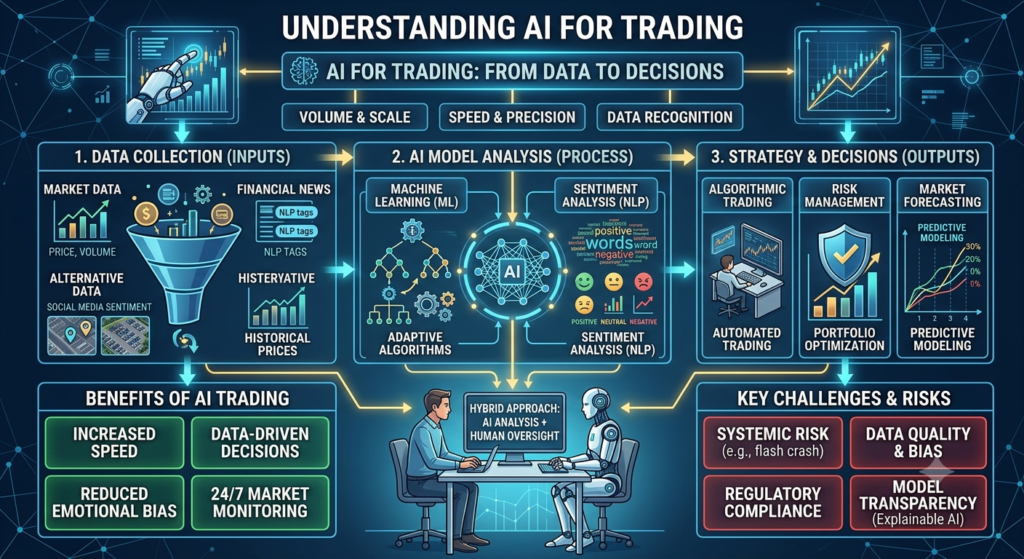
AI for trading is the use of artificial intelligence to study financial markets, identify patterns, and support better trading decisions. Unlike traditional systems, AI trading combines machine learning, predictive analytics, and real-time market data to improve accuracy.
It can power AI trading bots, automate repetitive tasks, and analyze stocks, forex, or cryptocurrencies within seconds. Whether you’re using AI trading software or an AI trading platform, the goal is to make trading faster, smarter, and more data-driven while reducing emotional decision-making.
How AI for Trading Works
AI for trading works by collecting real-time and historical market data from different sources. It uses machine learning, deep learning, and predictive analytics to recognize price patterns, analyze trends, and generate trading signals. Many AI trading platforms and AI trading bots can automatically place trades based on predefined rules or AI-generated insights. As they process more data, these systems continuously improve their performance, helping traders make faster, more informed, and data-driven decisions across stocks, forex, and cryptocurrency markets.
Technologies Behind AI Trading
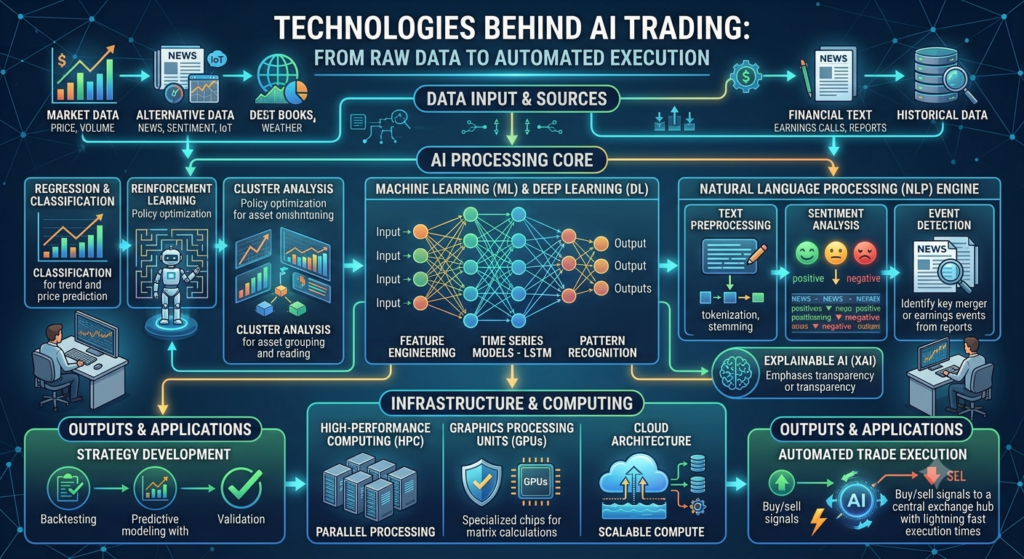
Several advanced technologies power AI for trading. Machine learning helps AI learn from historical and real-time market data, while deep learning identifies complex price patterns. Natural Language Processing (NLP) analyzes financial news, earnings reports, and social media sentiment to understand market trends. Some AI trading software also uses Large Language Models (LLMs) to summarize information and support research. Together, these technologies help AI trading platforms deliver faster insights, improve decision-making, and support smarter trading strategies.
Types of AI Trading Systems
There are several types of AI trading systems, each designed for different trading goals. AI trading bots automatically execute trades based on predefined rules or market signals. Machine learning trading models improve predictions by learning from historical data, while quantitative trading systems analyze large datasets to find profitable opportunities.
Robo-advisors help investors manage portfolios automatically. Whether you choose AI trading software for stocks, forex, or crypto, selecting the right system depends on your experience, strategy, and risk tolerance.
AI in Different Financial Markets
AI for trading is used across many financial markets to improve speed and accuracy. In AI stock trading, it analyzes price movements and company data to identify opportunities. AI forex trading tracks currency trends and economic events, while AI crypto trading monitors highly volatile digital assets around the clock. AI also supports trading in commodities, futures, and options by processing real-time market data, helping traders make informed, data-driven decisions in different market conditions.
Benefits of AI for Trading
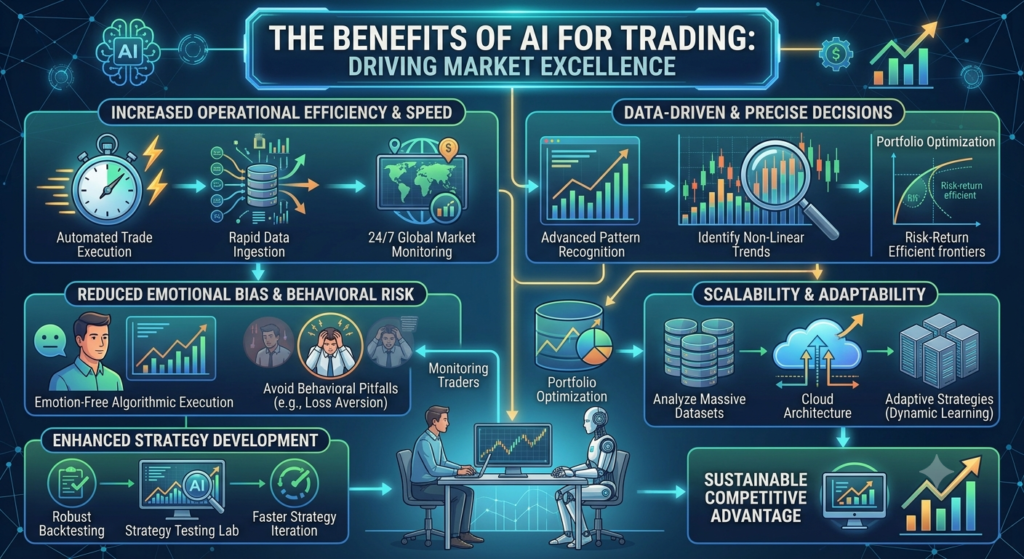
AI for trading offers many advantages for both beginners and experienced traders. It can analyze large amounts of market data in seconds, helping users spot opportunities that might otherwise be missed. AI trading platforms and AI trading bots work 24/7, reduce emotional decision-making, and automate repetitive tasks. By using machine learning and predictive analytics, AI trading software can improve efficiency, support better risk management, and help traders make faster, more informed decisions across different financial markets.
Risks and Limitations
While AI for trading offers many benefits, it also has limitations. AI trading software depends on high-quality data, so inaccurate or outdated information can lead to poor decisions. Sudden market events and unexpected volatility may reduce the accuracy of AI trading bots and machine learning trading models. Technical failures, overfitting, and cybersecurity risks are also important concerns. Successful trading still requires human oversight, proper risk management, and regular monitoring to adapt to changing market conditions.
Frequently Asked Questions (FAQs)
What is AI for trading?
AI for trading uses artificial intelligence, machine learning, and predictive analytics to analyze market data, identify trading opportunities, and support faster, data-driven decisions. It is widely used in stock, forex, and cryptocurrency markets.
Can AI predict the stock market?
AI can recognize patterns and forecast possible market trends based on historical and real-time data. However, no AI trading software can predict the stock market with complete accuracy because markets are influenced by unexpected events.
Is AI trading profitable?
AI trading can improve efficiency and help identify opportunities, but profitability depends on your strategy, market conditions, and risk management. There are no guaranteed profits.
What is the best AI trading platform?
The best AI trading platform depends on your experience, trading goals, supported markets, automation features, and budget. Compare features, pricing, and security before making a decision.
Can beginners use AI trading?
Yes. Many AI trading platforms and AI trading bots are designed for beginners with user-friendly dashboards, automated strategies, and educational resources to simplify the trading process.