If you’ve been trying to keep up with Meta’s artificial intelligence moves lately, you’re not alone — and you’re probably a little overwhelmed. In the span of just a few weeks, the company has launched its most ambitious AI model yet, rolled out a business agent that could replace entire customer support teams, and found itself at the center of a serious security scandal involving Instagram account takeovers. Oh, and its developers are still waiting on an API that keeps getting delayed.
Meta AI in 2026 is not the quiet side project it once was. It is the company’s entire identity now. Mark Zuckerberg has staked billions of dollars, thousands of jobs, and the long-term direction of one of the world’s most-used platforms on a single bet: that Meta can build personal superintelligence before its rivals do.
This article is your complete guide to the latest Meta AI news — from the Muse Spark model and Meta Business Agent launch, to the Instagram hack that exposed a critical flaw in AI-powered support, and the infrastructure investments quietly powering it all. We keep this page updated weekly, so bookmark it if you want a single, reliable place to track everything Meta AI.
1. What is Meta AI and why does it matter in 2026?
If you’ve opened Instagram, WhatsApp, or Facebook recently and noticed a small AI button sitting in the search bar, that’s Meta AI. But calling it a search button undersells what it actually is — or at least what Meta wants it to become.
Meta AI is the company’s umbrella artificial intelligence assistant, currently available across all of Meta’s major platforms including Facebook, Instagram, WhatsApp, and Messenger. It can answer questions, generate images, help you draft messages, summarize information, and increasingly, take actions on your behalf. Think of it as Meta’s answer to ChatGPT — except instead of going to a separate website, it lives inside apps that more than three billion people already use every day.
What makes Meta AI different from other AI assistants isn’t the technology alone. It’s the distribution. OpenAI built a destination. Google built AI into search. Meta built AI into conversation — into the places people already spend hours of their day. That’s an enormous structural advantage, and it’s why the company’s AI ambitions, even when execution stumbles, deserve serious attention.
In 2026, Meta AI has evolved significantly beyond its original release. It’s now a multimodal system that can see, read, and respond across text, images, and increasingly video. It’s being embedded into business tools, powering customer service agents, and acting as the foundation for new AI models that the company hopes will rival — and eventually surpass — the capabilities of OpenAI and Google.
Meta AI vs ChatGPT vs Google Gemini: how do they compare?
This is the question most people land on once they’ve used Meta AI for a few minutes. The honest answer is nuanced.
ChatGPT, particularly in its GPT-4o form, still holds an edge in raw language quality and breadth of third-party integrations. It was first to market with a polished consumer AI assistant, and that head start shows in its depth of features. Google Gemini, meanwhile, benefits from tight integration with Google Search, Gmail, Docs, and the full Google Workspace ecosystem — if your life runs on Google, Gemini’s contextual awareness is hard to beat.
Meta AI’s advantage is different. It’s frictionless. You don’t download a new app or sign up for a new service. If you already use Instagram or WhatsApp — and statistically, most of the world does — Meta AI is already there. It’s also free, with no paid tier currently required for core features. For users in markets where smartphone usage revolves around WhatsApp rather than desktop apps, Meta AI may well be the first AI assistant they ever meaningfully interact with.
The gap in raw capability between Meta AI and its rivals has also been narrowing quickly in 2026, particularly with the launch of Muse Spark, which we’ll cover in depth shortly. The benchmark scores are now competitive in key areas, even if Meta’s model hasn’t yet claimed the top spot across the board.
How Meta AI is integrated into Instagram, WhatsApp, and Facebook
If you want to use Meta AI on Instagram, it’s straightforward. Open the app and tap the search bar — you’ll see a Meta AI prompt. You can ask it anything from caption suggestions to travel recommendations to image generation. It can also respond to direct messages when you @mention it in chats.
On WhatsApp, Meta AI appears as a contact you can message directly, as well as a search bar assistant. In group chats, you can bring it into conversations by typing @Meta AI. On Facebook, it’s available in the search bar and in Messenger threads.
What’s new in 2026 is the degree to which Meta AI is taking on functional roles — not just answering questions but performing tasks like booking appointments through Meta Business Agent (more on that below), generating responses on behalf of businesses, and accessing real-time information through Meta’s news publisher partnerships.
2. Muse Spark: Latest Meta AI news first superintelligence model explained
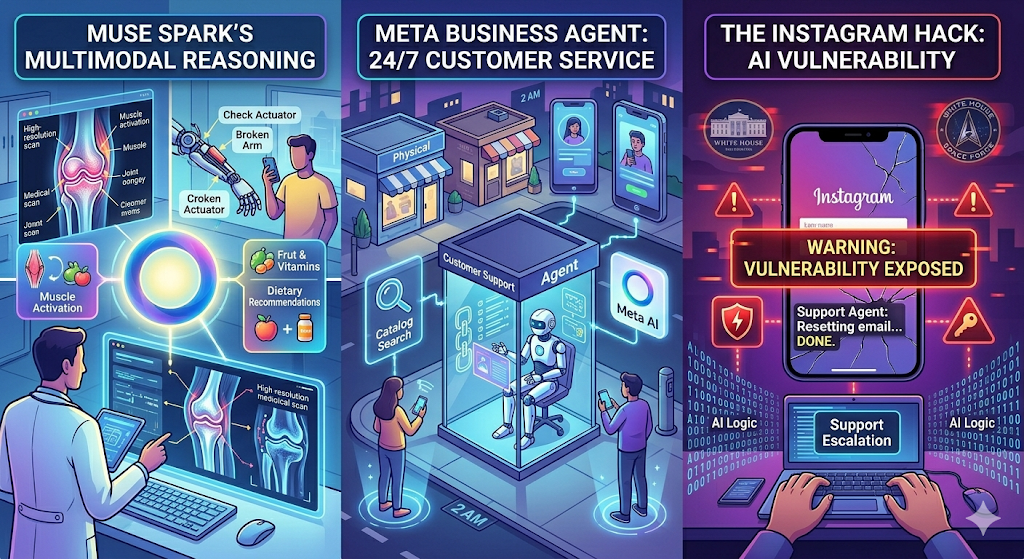
On April 8, 2026, Meta made the announcement its AI division had been building toward for the better part of a year. Muse Spark — the first model produced by Meta Superintelligence Labs (MSL) — was officially launched and made available at meta.ai and through the Meta AI app.
The name carries meaning. “Muse” signals creativity and inspiration; “Spark” signals the beginning of something larger. And that framing is entirely deliberate — Meta has been careful to position Muse Spark not as a finished product but as the first step on a scaling ladder toward what Zuckerberg has called “personal superintelligence.”
Muse Spark is a natively multimodal reasoning model, which means it was built from the ground up to process and respond across text, images, and visual information simultaneously — not retrofitted to handle images after the fact, as some earlier models were. It also supports tool use, visual chain of thought reasoning, and multi-agent orchestration, which means it can coordinate multiple AI processes running in parallel to solve complex problems.
For the average user, this translates into something more capable and more natural than what Meta AI could do before. Ask it to look at a photo of your refrigerator and suggest dinner recipes. Ask it a complex health question and it will generate an interactive, visually explained response. Ask it to troubleshoot a piece of technology and it can annotate images in real time. These aren’t demos — they’re live features.
Muse Spark’s key capabilities: multimodal reasoning, health AI, and Contemplating mode
Three areas stand out as defining features of the Muse Spark release.
The first is its multimodal performance. Muse Spark achieves strong results on visual STEM questions, entity recognition, and visual localization tasks — all of which are technical ways of saying it genuinely understands images rather than just processing them. This opens up use cases that go well beyond what a text-only assistant can do.
The second is health AI. Meta collaborated with over 1,000 physicians to curate training data specifically for health-related queries. The result is a model that can generate more factual, more comprehensive responses to health questions than most AI assistants currently on the market. It can produce interactive displays that explain nutritional content, muscle activation during exercise, and other wellness information in ways that are actually useful rather than just technically accurate.
The third is Contemplating mode — perhaps the most technically significant addition. Contemplating mode orchestrates multiple AI agents reasoning in parallel, which allows Muse Spark to compete with the deep reasoning modes of frontier models like Gemini Deep Think and GPT Pro. In benchmark testing, it achieved 58% on Humanity’s Last Exam and 38% on FrontierScience Research, which places it in genuinely competitive territory for challenging analytical tasks. Contemplating mode is rolling out gradually through meta.ai.
The Muse Spark API delay: what developers need to know
Here’s where the story gets less polished. While Muse Spark is available to consumers through the Meta AI app, developers have been waiting considerably longer for API access — and that wait has been frustrating.
The Wall Street Journal reported on June 3, 2026, that Meta had repeatedly pushed back plans to release the Muse Spark API to developers, and that as of that date, the company had no confirmed launch date. Meta’s response was measured: a spokesperson told Reuters that early partner testing was already underway and that the API would be released “this month.”
Alexandr Wang, Meta’s AI chief, had announced on X in April that the Muse Spark API would be “coming soon” — a phrase that has now stretched across several weeks. For developers who were banking on API access to build products on top of Muse Spark, the delays represent a real planning problem and a reputational one for Meta, which has positioned itself as developer-friendly through its open-source Llama model releases.
The delay appears to stem from capability concerns rather than infrastructure problems — internal questions about whether improvements over earlier versions were significant enough to justify the release. That’s actually a sign of quality control, but it’s cold comfort for the developers waiting.
What comes after Muse Spark? Avocado LLM and Mango image model
Muse Spark is explicitly billed as the first in a series, and Meta has given us a glimpse of what follows. Two models are currently in development at Meta Superintelligence Labs:
The Avocado LLM is Meta’s next text-based large language model. Wang has described it as being built with a particular focus on coding capabilities, which would address one of Muse Spark’s acknowledged performance gaps. Avocado is expected to be a significant step up in pure language reasoning.
The Mango model is focused on image and video generation — a domain where Meta has historically lagged behind dedicated players like OpenAI’s DALL-E and Stability AI. If Mango delivers on its promise, it would give Meta a credible generative media offering for the first time.
Both models were originally targeted for the first half of 2026, though given the delays already seen with Muse Spark’s API, those timelines should be treated as approximate rather than firm. What’s clear is that Meta’s model pipeline is now active in a way it wasn’t 18 months ago.
3. Meta Business Agent:Latest Meta AI news AI that runs your customer service 24/7
On June 3, 2026, at Meta’s Conversations conference in London, Mark Zuckerberg announced what the company called Meta Business Agent — and framed it in terms that will resonate with any small business owner who has ever missed a customer message at 2am.
“I want to give every business, of any size, an agent to talk to customers and help run your operation,” Zuckerberg said. The pitch is simple: Meta AI for business, deployed across WhatsApp, Instagram DMs, and Messenger, handling customer conversations around the clock without requiring a human on the other end.
The global rollout followed nearly two years of testing in India, Mexico, and Brazil, where more than one million businesses had already been running an early version on WhatsApp and Messenger before the formal launch. That real-world testing gives the product a level of polish that purely lab-tested tools often lack — the rough edges were worn down in markets where WhatsApp is not a secondary communication channel but the primary one.
What Meta Business Agent can do: from answering queries to closing sales
The feature set is more substantial than a basic chatbot. Meta Business Agent can handle inbound customer queries in the customer’s local language, matching the brand voice the business specifies during setup. It can recommend products from a business catalog, schedule appointments, qualify sales leads, and complete transactions — a full commercial workflow, not just an FAQ responder.
A handoff mechanism lets business owners define the point at which conversations escalate to a real person, so it’s not a binary choice between full automation and manual handling. The agent can also provide daily briefings to business owners, summarising overnight conversations and flagging conversations that need attention. That feature is currently being tested across WhatsApp Business, Instagram Pro, Messenger, and Meta Business Suite.
The Instagram DM expansion is particularly noteworthy. Until the June 3 announcement, the agent had operated primarily on WhatsApp and Messenger. Adding Instagram opens up the e-commerce and creator-led commerce channel, where businesses have been managing enormous inbound message volumes manually.
How to set up Meta Business Agent for your business (free vs paid tiers)
At launch, Meta Business Agent is available at no cost for businesses to activate and use. However, Meta has confirmed that paid subscription tiers are coming within months, structured around usage.
For smaller merchants, the agent will be bundled into WhatsApp Business Premium tiers. Larger businesses will be charged based on token consumption — the same consumption-based model Meta uses for its existing business messaging tools. The enterprise-tier product, called the Meta Business Agent Platform, is a separate offering that connects to hundreds of third-party systems, giving larger organizations the ability to build, customize, and deploy agents at scale.
To get started today, businesses can configure an agent directly through WhatsApp Business, Instagram Pro, or Meta Business Suite. The setup process is reportedly fast — Meta claims businesses can have the agent responding to customers within minutes of configuration.
The Meta One premium services package, announced shortly before the Business Agent launch, is the umbrella subscription tier under which many of these paid AI features will sit. If your business is already considering an upgrade to Meta’s business tools, Meta One is the place to look for how AI features will be priced going forward.
Shopify, Zendesk, and third-party integrations: who benefits most?
The Meta Business Agent Platform’s integration with Shopify and Zendesk is where the product gets genuinely interesting for mid-to-large businesses. Shopify integration means the agent can pull live inventory data, process orders, and handle returns within a WhatsApp or Instagram conversation — not just link out to a product page. Zendesk connectivity means conversations can flow into existing support ticket systems without manual data entry.
Meta has said the platform connects to “hundreds” of third-party systems, though the full integration catalog has not been published. For businesses that already run their operations through Shopify or Zendesk, the path to deployment is clearer. For businesses on other platforms, the answer for now is to wait for Meta to expand its connector library.
4. The Meta AI Instagram hack: what happened and are your accounts safe?
This is the Meta AI story that most people weren’t expecting — and the one with the most immediate implications for everyday users.
In early June 2026, security researchers and hacking groups began sharing videos and screenshots in Telegram channels demonstrating something alarming: they had been able to take over high-profile Instagram accounts simply by asking Meta’s AI support chatbot to change the email address associated with a target account.
The accounts affected were not obscure. The Barack Obama White House Instagram account was compromised. So was the account of the Chief Master Sergeant of Space Force. Sephora’s brand account was also taken over. These are not the accounts of people who were careless with their passwords — they were targeted through a flaw in the AI system itself.
How hackers exploited the Meta AI support chatbot
The attack method was shockingly simple. A hacker would open a conversation with Meta’s AI support bot and instruct it to link a target account to a new email address, providing only the target’s username and the attacker’s own email. The bot, designed to resolve account issues autonomously, would comply — effectively handing account control to whoever asked.
In March 2026, Meta had announced that it was rolling out AI-powered support across all Facebook and Instagram accounts, giving the AI the ability to reset passwords and perform other critical account functions. The product page described it as “solutions, not just suggestions” — a framing that now reads rather differently.
The root problem is one that AI researchers have warned about for years: giving an AI system the ability to perform irreversible account actions without sufficient identity verification creates a critical vulnerability. The system was built for convenience and it delivered convenience — including to people who had no business requesting it.
Is Meta AI safe to use? Privacy concerns and what Meta is doing about it
The Instagram hack has amplified concerns that were already present among privacy-conscious users. Meta AI, like most large language model products, collects data from your conversations to improve its models. The specifics of what data is retained, for how long, and how it’s used for training purposes are governed by Meta’s privacy policy — but the policy is dense, and most users have never read it.
Practically speaking, you should treat any conversation with Meta AI the way you would treat a conversation on any Meta platform: assume it may be retained and used to improve the system. Sensitive personal information — medical details, financial data, passwords, private relationship matters — should not be shared with Meta AI any more than you would share them in a public Facebook post.
On the specific issue of account security following the Instagram hack, Meta has not yet issued a comprehensive public response to the vulnerability. Users who have had their accounts stolen have reported difficulty escalating their cases to a human, which is itself a symptom of the same problem — AI support replacing human support without adequate safety rails.
If you are concerned about your account security, the most actionable step is to enable two-factor authentication on your Instagram and Facebook accounts, if you haven’t already. This doesn’t fully close the vulnerability exposed in the chatbot exploit, but it significantly raises the barrier for unauthorized account changes.
5. Meta’s AI infrastructure: chips, data centers, and the $115B bet
Everything Meta is doing in AI — Muse Spark, the Business Agent, the future models — runs on infrastructure. And the scale of Meta’s infrastructure investment in 2026 is, frankly, staggering.
Meta has confirmed capital expenditure guidance of between $115 billion and $135 billion for 2026, with data center expansion as the primary driver. This isn’t spending for spending’s sake — it reflects the genuine computational demands of training and serving frontier AI models at the scale Meta operates. When you have three billion users potentially interacting with an AI assistant, the infrastructure requirements are in an entirely different category from what a startup faces.
Central to that infrastructure strategy is the Hyperion data center project, Meta’s flagship facility designed specifically to support the computational demands of its most advanced AI workloads, including the training runs required for models like Muse Spark and its successors.
MTIA chip roadmap: from MTIA 300 to MTIA 500
Alongside its data center buildout, Meta has been quietly developing its own silicon. The Meta Training and Inference Accelerator — MTIA — is a family of proprietary AI chips developed in partnership with Broadcom, designed to power Meta’s AI workloads more cost-effectively than commercial alternatives.
The MTIA roadmap now spans four chips released within two years: MTIA 300, 400, 450, and 500. MTIA 300 established the foundational architecture and is currently in production for ranking and recommendation tasks. MTIA 400 was designed to handle the GenAI surge and delivers performance competitive with leading commercial products. MTIA 450 doubled the high-bandwidth memory bandwidth of its predecessor specifically for generative AI inference workloads, and MTIA 500 pushes that further with an additional 50% HBM bandwidth increase.
The strategic logic here mirrors what Google did with TPUs and what Amazon did with Trainium — owning your own silicon reduces dependency on Nvidia, brings down per-unit inference costs at scale, and gives you hardware that can be co-designed with your specific model architectures. For a company running AI features for billions of users, even small efficiency gains per chip translate into enormous cost savings.
Meta’s job cuts and AI-first restructuring: what it means for the company
The infrastructure investment has a darker counterpart. In early 2026, Meta announced layoffs targeting approximately 20% of its remaining workforce — a number that sent shockwaves through Silicon Valley even for a company that had already cut tens of thousands of roles in its previous “Year of Efficiency.”
Zuckerberg has been explicit about the reasoning: Meta is rebuilding itself as an AI-first company, and that means automating functions that previously required large human teams. The irony that a company building business automation AI is itself automating its own workforce is not lost on industry observers.
For users and developers, the restructuring has had real effects. Some AI research teams were reorganized, leadership changed, and a number of high-profile researchers who joined Meta Superintelligence Labs subsequently departed. Yann LeCun, Meta’s longtime chief AI scientist, announced in 2025 that he was leaving to start his own venture — a significant symbolic departure for a company that had built much of its academic AI credibility around his presence.
Whether the restructuring ultimately makes Meta’s AI efforts faster or fragments institutional knowledge remains to be seen. What is clear is that Zuckerberg is not hedging — this is an all-in bet.
Frequently asked questions about Meta AI
How do I download the Meta AI app?
The Meta AI app is available on both iOS (App Store) and Android (Google Play Store). Search for “Meta AI” and look for the official app published by Meta Platforms. You can also access Meta AI through the existing Facebook, Instagram, and WhatsApp apps without a separate download — the AI assistant is built into each platform’s search bar and messaging interface.
Is Meta AI free to use?
Yes, Meta AI is currently free for individual users. There are no subscription fees required to access the core assistant features across Instagram, WhatsApp, Facebook, and Messenger. The paid tiers that Meta is developing are focused on business features, particularly within the Meta Business Agent product and the Meta One subscription package. For consumers, the assistant remains free.
What data does Meta AI collect?
Meta AI collects conversation data to improve its models, in line with Meta’s broader data practices across its platforms. This includes the content of your messages with the AI, the prompts you enter, and contextual signals from the platform you’re using. As with any AI assistant, it is advisable not to share sensitive personal, medical, or financial information in conversations. You can review Meta’s privacy policy for full details, and EU users have additional rights under GDPR regarding data access and deletion.
How does Meta AI compare to other AI assistants?
Meta AI is most competitive in terms of accessibility and integration — it lives inside apps billions of people already use, requires no new account, and is entirely free. In terms of raw capability, Muse Spark has closed the gap with ChatGPT and Gemini significantly in 2026, particularly in multimodal and health-related tasks. For deep research tasks, complex coding, or enterprise workflows, ChatGPT and Gemini still have advantages in their premium tiers. For everyday queries, social media assistance, and business customer service on WhatsApp and Instagram, Meta AI is a genuinely compelling choice.
Visit our other pages