1. Introduction
Something quietly shifted in the AI landscape at the start of this year. The conversations that used to circle around ‘what could AI eventually do?’ have been replaced by a blunter question: ‘when exactly is this going live?’ That shift is what agentic AI news in 2026 is really about. We have moved past the era of impressive demos and into an era of operational reckoning — where autonomous AI systems are either earning their place in production or getting cancelled before they ever reach it.
The numbers behind this transition are striking. Gartner puts total spending on agentic AI at $201.9 billion for 2026 alone — a 141% jump from 2025 — and projects that by 2027, enterprise spending on AI agents will overtake what companies spend on traditional chatbots and assistants combined. Those are not exploratory budgets. That is infrastructure money, which means the pressure to deliver real results has arrived.
This article walks through every major dimension of that story: the market forces driving adoption, the breaking news stories defining the space, the industries where AI agents are actually working, the stubborn gap between pilots and production, the governance crises brewing beneath the surface, and what the Model Context Protocol (MCP) means for the future architecture of enterprise AI. We also address the question that everyone is quietly asking about the workforce — and give you the most honest, evidence-backed answer available.
Whether you are tracking agentic AI news for strategic planning, investment decisions, or simply trying to understand what autonomous AI systems mean for your industry, this guide covers the full picture as of May 2026.
2. Definition
What Is Agentic AI? A Plain-Language Definition for 2026
Not everyone who searches for agentic AI news needs a computer science degree to understand the answer — so let’s be direct. An AI agent is a software system that can perceive its environment, make decisions, take actions, and learn from the results, all with minimal human intervention in between. That last part is the crucial distinction. Unlike generative AI, which responds to a prompt and then waits, an agentic AI system acts on its own initiative toward a goal.
Think of the difference this way: a generative AI model is like a highly capable consultant you call up when you have a question. An agentic AI system is more like a capable employee who takes a brief, goes away, figures out what needs to be done, makes judgment calls along the way, and returns with a completed deliverable. The autonomy is the point.
From Chatbots to Agents — The Evolution in Plain Terms
The progression from early chatbots to today’s autonomous AI systems has not been a straight line. Early chatbots followed rigid scripts. Large language models made conversations feel more natural but still required a human prompt for every response. Generative AI tools like the early versions of Claude or GPT could draft content, write code, or summarise documents — but they sat idle between requests.
Agentic AI broke that pattern by giving models the ability to use tools, reason across multiple steps, and execute long-horizon tasks. A modern AI agent might be asked to research a competitive landscape, pull live data from five different APIs, cross-reference it against a company’s internal documents, draft a strategy memo, schedule a review meeting, and flag one anomaly it found along the way — all without a human directing each step. That is a fundamentally different relationship between a human and a machine.
The distinction between agentic AI and generative AI also matters for the market. Generative AI democratised content creation. Agentic AI is starting to democratise execution — and that is a far larger economic prize.
3. Market Size & Growth
Agentic AI Market Size, Growth & Forecasts: The Numbers Defining 2026
The market data surrounding agentic AI in 2026 is worth reading slowly, because several of the numbers are genuinely unusual for an enterprise technology at this stage of adoption.
| $8.03B Market value in 2025 Belitsoft / TrendForce | $11.78B Market value in 2026 CAGR: 46.61% | $201.9B Gartner spend forecast 141% YoY growth |
A CAGR of 46.61% is extraordinary by any standard. For reference, the early cloud computing market grew at roughly 18% annually during its formative years. Agentic AI is expanding at more than twice that rate. Long-term projections place the market at $251.38 billion by 2034, which would make it one of the largest technology categories ever created.
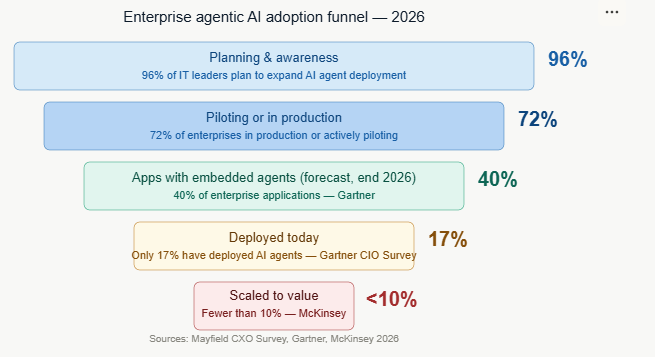
Gartner’s CIO Survey adds important texture to the adoption picture. Only 17% of enterprises have actually deployed AI agents to date — but more than 60% have committed to doing so within the next two years. That gap between current deployment and declared intent represents one of the most significant technology build-outs in recent corporate history.
Hardware Ripple Effect: The $1.28 Trillion Memory Market
One part of the agentic AI story that gets less attention in general news coverage is the hardware infrastructure it demands. Agentic AI workloads are fundamentally more memory-intensive than standard generative AI tasks, because agents need to maintain context across long sequences of reasoning steps, tool calls, and retrieved documents. This is driving a structural expansion in demand for high-bandwidth memory (HBM) and DRAM.
TrendForce projects the global memory market will reach $1.28 trillion by 2027, in large part because of the inference-centric AI workloads that agentic deployments require. KV cache scaling — the technical mechanism that lets agents hold extended context in memory — is emerging as one of the key bottlenecks and investment priorities for enterprise AI infrastructure teams. For anyone tracking the agentic AI market size from a hardware or semiconductor angle, this trajectory is as important as the software layer above it.
Investment Landscape: Funding Flows and the 2026 Shakeout
Venture capital is following the market signal. Dust raised a $40 million Series B to build agent-to-agent communication infrastructure. E2B secured $355 million in a Series C to provide sandboxed execution environments for AI code agents. Anthropic secured more than $1.5 billion in capital commitments for a new program that embeds engineers inside mid-sized enterprises to implement AI systems including Claude Code.
But the investor community is also starting to ask harder questions. Fewer than 10% of enterprises that have experimented with agentic AI have actually scaled agents to deliver measurable value, according to McKinsey. That figure, combined with Gartner’s prediction that 40% of agentic AI projects will be cancelled by the end of 2027, signals that the funding bonanza is entering a more disciplined phase — one where agentic AI startup funding will increasingly flow to teams that can demonstrate production outcomes, not just compelling demos.
4. Top Stories — May 2026 ★ GAP SECTION
Top Agentic AI News Stories: What Happened in May 2026
Agentic AI news this month reflects a market that has entered what devFlokers called the ‘Agentic Pivot’ — a decisive move from isolated experiments toward autonomous systems capable of reasoning, tool use, and cross-platform orchestration. Here are the developments worth tracking.
ServiceNow and Accenture Launch the First Major Pilot-to-Production Program
On 6 May 2026, ServiceNow and Accenture announced a forward deployed engineering (FDE) program specifically designed to help enterprises take agentic AI from pilot to production at scale. The program embeds ServiceNow’s AI-native engineers inside mutual customers’ environments alongside Accenture industry specialists, building agentic workflows on the ServiceNow AI Platform where enterprise work already runs. It is perhaps the clearest institutional acknowledgement yet that the pilot-to-production gap is not a product problem — it is an implementation problem.
Meta Builds an Agentic Consumer Assistant on Muse Spark
Meta is developing a highly personalised AI assistant powered by its Muse Spark model, designed to perform tasks autonomously across software and hardware environments with far less human intervention than traditional chatbots. The company is also testing an internal AI agent called ‘Hatch’ and plans to integrate agentic shopping features into Instagram before the end of the year. Meta’s Muse Spark acquisition of Chinese agentic AI startup Manus — following its relocation to Singapore — also reflects how major corporations are navigating the competitive geopolitical landscape around AI agent development.
Agentic AI Product Launches: MCP Spreads Beyond Developer Tools
Zylo announced support for Model Context Protocol as part of its enterprise spend-optimisation platform, a move that signals MCP adoption expanding from developer infrastructure into business operations software. Prismatic released an open-source Claude Code plugin on 4 May to speed integration development. Google Cloud unveiled its eighth-generation TPUs specifically engineered for the low-latency, high-throughput demands of agentic AI workloads. These agentic AI product launches in May 2026 collectively point in one direction: the infrastructure layer is maturing fast enough to meet enterprise demand.
IBM’s Agentic Pivot and the Infrastructure Wars
IBM announced its own agentic pivot strategy, partnering with Google Cloud to position its Watsonx platform as an enterprise orchestration layer for multi-agent deployments. Meanwhile, OpenAI restructured its exclusive partnership with Microsoft to distribute products across rival cloud providers, and Amazon entered talks for a $10 billion investment in OpenAI — both signals that the compute infrastructure required for agentic workloads is growing faster than any single provider can satisfy.
The biggest agentic AI news in May 2026 is not a single product launch — it is the emergence of production-grade infrastructure. The foundational plumbing for enterprise agents is finally being built in earnest.
5. Enterprise Adoption & Use Cases
Where Enterprises Are Actually Deploying AI Agents Right Now
Adoption statistics can create a misleading picture of uniformity. In practice, agentic AI deployment in 2026 is heavily concentrated in a handful of verticals where the ROI case is sharpest and the tolerance for AI-driven action is highest. Here is where things stand on the ground.
Healthcare: Documentation, Triage, and the 42-Minute Daily Gift
Healthcare has emerged as one of the most compelling early adopters of agentic AI, largely because the administrative burden on clinicians is both enormous and well-defined. A clinical assistant AI agent studied in a 2026 deployment reached an 80% adoption rate among test providers and cut documentation time by 42% — freeing approximately 66 minutes per clinician per day. Multiply that across a large hospital system and the case is overwhelming. Agentic AI in healthcare is now expanding from documentation into patient triage, diagnostic support, and drug discovery timelines, where one healthcare CIO noted their organisation cut wait times from 42 minutes to under one minute after removing AI-driven friction from triage workflows.
Banking & Finance: From Fraud Detection to Autonomous Payments
Agentic AI banking applications are advancing on several fronts simultaneously. Fraud detection agents can monitor transaction streams in real time, identify anomalous patterns, and take immediate protective action without waiting for a human compliance officer. AI credit decisions automation is reducing lending approval cycles from days to minutes. Santander has piloted live agentic payments processing. Robinhood launched an AI agent for autonomous stock trading and credit card management in May 2026. And in retail banking, customer interaction agents are handling everything from debt management queries to savings reallocation recommendations — tasks that previously required a human adviser.
The agentic AI banking sector is also where governance matters most. Banking is one of the most regulated industries in the world, and the risks of agentic AI — prompt injection, data exfiltration, and autonomous credit decisions made on faulty premises — carry legal consequences that are far more immediate than in other sectors.
Software Development: AI Coding Tools Redefine Developer Output
Agentic AI coding tools have arguably had the most immediate, measurable impact of any deployment category. Claude Code, Google Jules, Amazon Kiro, Cursor, and Windsurf are all in widespread enterprise use as of Q2 2026. By April 2026, the limiting factor was no longer code quality — every major coding agent produces strong code. What separates productive deployments from stalled ones is the surrounding infrastructure: identity controls, audit logging, PR gates, and sandbox isolation. C3.ai launched C3 Code in April 2026, targeting businesses that need domain-specific coding agents rather than general-purpose models. The net result is that developer productivity in teams using agentic coding tools is dramatically higher — but the operational requirements are also dramatically higher.
Customer Service, Manufacturing, and the Next Wave
Citizens Bank is targeting 25% of call-centre volume through agentic AI customer service automation. IDC forecasts that by 2026, 40% of G2000 job roles will involve direct interaction with AI systems. Manufacturing and logistics are adopting agentic systems for supply chain optimisation and quality control. Legal, education, and EdTech are entering the early adoption phase, with personalised learning agents beginning to demonstrate measurable outcomes in assessment and tutoring contexts. Agentic AI customer service automation is now mature enough that most enterprise contact centre vendors have embedded it as a standard offering, not a premium add-on.
6. The Pilot-to-Production Problem ★ GAP SECTION
The Pilot-to-Production Problem: Why 79% Awareness Meets 11% Deployment
Here is the number that should be on every enterprise AI leader’s desk: according to multiple independent surveys, fewer than 10% of enterprises that have experimented with agentic AI have scaled it to deliver measurable value. The technology works in controlled environments. Getting it to work reliably across departments, geographies, and business functions is a different challenge entirely.
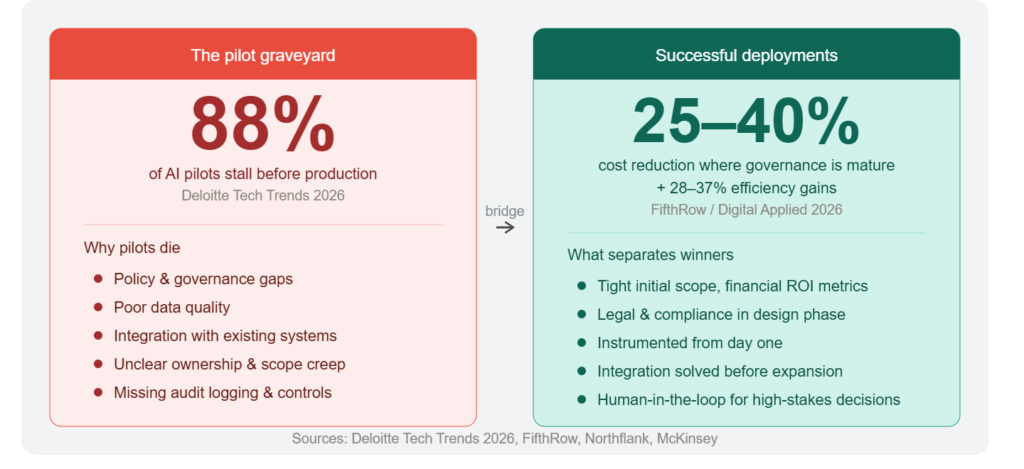
The failure mode is remarkably consistent across industries. It is almost never a model quality problem. By 2026, the major agentic AI models are genuinely capable. The problem is everything around the model: unclear ownership, poor data quality, governance vacuums, integration debt, and scope that expands faster than the infrastructure can support it. Northflank’s research puts the pilot failure rate at 85–90% — not because the AI is bad, but because the organisation around it is not ready.
What Kills Pilots Before They Reach Production
Deloitte’s 2026 Tech Trends report found that only about 20% of enterprises possess robust governance frameworks for agentic AI deployment, and that 88% of AI pilots stall before reaching production — overwhelmingly due to policy gaps, incomplete data context, and orchestration immaturity. The FifthRow analysis is blunter: agentic AI platforms are delivering 25–40% cost reductions and 28–37% efficiency gains where mature governance and orchestrated operations are in place. That qualifier — ‘where mature governance is in place’ — is doing enormous work in that sentence.
The specific killers are: lack of audit logging wired into security systems; absence of human-in-the-loop checkpoints for high-stakes decisions; model drift that goes undetected because there is no performance monitoring; and scope creep that converts a tightly defined pilot into an amorphous enterprise transformation program. Gartner predicts that 40% of agentic AI projects will be cancelled by the end of 2027 due to escalating costs, unclear business value, or inadequate risk controls. Forrester puts it more pointedly: enterprises that treat vendor selection as the end of the decision are setting themselves up for pilots that never reach production.
What Separates Successful Deployments
The organisations that are successfully getting agentic AI from pilot to production — EY, JPMorgan, Salesforce, Valeo — share a common pattern. They start with a tightly scoped use case, instrument everything from day one, bring legal and compliance into the design process before any deployment, and define success metrics that are financial rather than technical. They also treat integration with existing systems as the hardest part, not an afterthought. IDC’s data shows integration with existing systems is cited as the primary challenge by 46% of AI teams. The companies that solve that problem first tend to be the ones that scale.
The agentic AI deployment challenge in 2026 is not a technology problem. It is an organisational readiness problem. The companies winning are not the ones with the best models — they are the ones with the best governance.
7. Governance, Security & Risk
Governance, Security & the 60% Gap: What Enterprises Are Getting Wrong
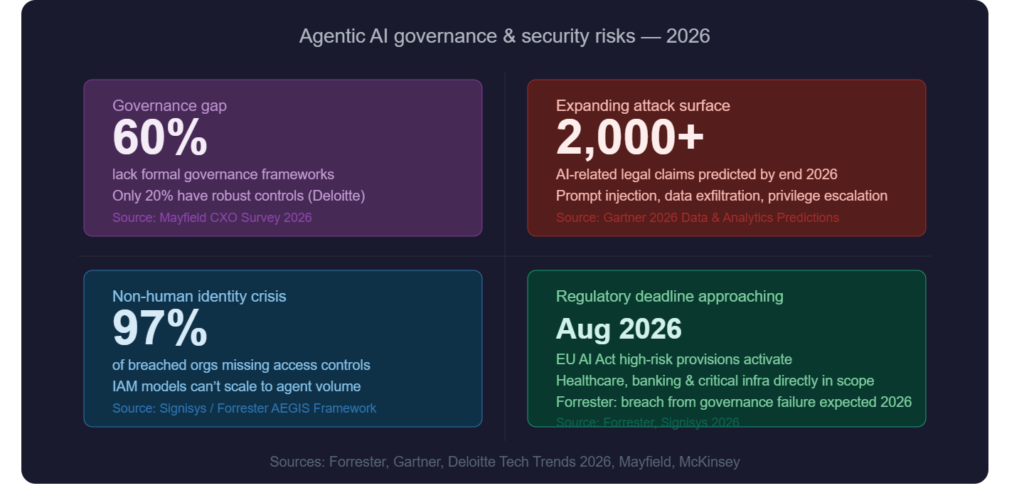
The 2026 CXO AI Survey found that while 72% of enterprises are either in production with or actively piloting agentic AI, 60% still lack formal governance frameworks for managing those deployments. That is not a small oversight. It is a structural vulnerability at enterprise scale — and the security community has noticed.
Forrester has been direct about the stakes. The firm describes 2026 as AI’s ‘hard hat’ phase, where cost control, governance, and operational reliability matter more than impressive demos. Forrester also predicts that an agentic AI deployment will cause a publicly disclosed data breach in 2026, leading to employee dismissals — and that the breach will result from systemic governance failures, not individual mistakes. With 63% of enterprises lacking AI governance policies and 80% reporting risky agent behaviours in production, the conditions for that prediction to come true already exist.
The Attack Surface That Agentic AI Creates
Traditional AI security focused on model outputs — preventing a chatbot from saying something harmful. Agentic AI security is fundamentally different because the system takes actions. A prompt injection attack against an AI agent does not just produce a bad response; it can cause the agent to exfiltrate data, escalate privileges, or take actions in connected systems that propagate damage across an entire enterprise stack. Gartner predicts that AI-related legal claims will exceed 2,000 by the end of 2026 due to insufficient risk guardrails. The attack surface includes access tokens bypassing identity controls, shadow agents operating outside governance programs, and cross-tenant data exposure through shared infrastructure.
Jeff Pollard, VP and Principal Analyst at Forrester, put it plainly: ‘What’s different with agents is we’re giving them agency. This is really the first time we have widely deployed software in our environment that has an intent — a goal — and has the ability to go do something without us explicitly telling it what to do.’ That distinction — software with intent — requires a security model that IAM and traditional data governance frameworks were not built for.
Non-Human Identity Management: The IAM Crisis No One Is Solving
This is the gap section that none of the major agentic AI news outlets have adequately covered yet: the identity management crisis created by AI agents. Every agent that acts in an enterprise environment needs an identity, permissions, and an audit trail. The problem is that organisations are deploying agents far faster than they are creating the identity infrastructure to govern them.
Forrester’s AEGIS Framework — a 39-control blueprint for agentic AI security — maps to NIST AI RMF, the EU AI Act, OWASP, MITRE ATLAS, and ISO/IEC 42001:2023. But fewer than 20% of enterprises have implemented even the foundational controls it describes. The non-human identity management problem is not hypothetical. It is the most likely root cause of the agentic AI data breach that Forrester predicts will occur this year.
The EU AI Act’s August 2026 Deadline
The EU AI Act’s provisions for high-risk AI systems take effect in August 2026, and agentic AI deployments in healthcare, banking, and critical infrastructure will be directly in scope. Compliance gaps emerge specifically around the inability to explain automated decisions in regulated contexts, missing audit trails required for regulatory review, and discriminatory recommendations masked by automation complexity. Agentic AI governance for enterprises operating in the EU is no longer a future consideration — it is an August 2026 requirement.
8. Regulation — Entirely Unclaimed by Competitors ★ GAP SECTION
Agentic AI Regulation 2026: What Governments and Regulators Are Doing
Of all the topics in the agentic AI news landscape, regulation is perhaps the one that receives the least rigorous coverage relative to its importance. Most outlets skim past it on the way to the next product launch. That is a mistake, because the regulatory environment in 2026 is actively shaping which deployments are viable and which are not.
The clearest deadline in the immediate term is the EU AI Act. Its high-risk provisions activate in August 2026 and will affect every enterprise deploying agentic AI in healthcare, finance, law enforcement, critical infrastructure, or education within the European Union. The Act requires transparency, human oversight, and lifecycle risk documentation for high-risk AI systems — requirements that are straightforward to declare but technically demanding to implement for systems designed to act autonomously.
The US Regulatory Picture: Export Controls and the Pentagon Divide
US agentic AI regulation in 2026 is shaped by two forces pulling in opposite directions. On one side, federal export controls on advanced AI chips and models are accelerating, driven by national security concerns about Chinese AI capabilities. On the other side, the commercial AI sector — and specifically companies like Anthropic — is navigating a bifurcated market created by the Pentagon’s classified AI programs, which have created tension between military applications and the safety-first principles that frontier AI labs built their reputations on.
The agentic AI accountability frameworks that will eventually govern US deployments are still being designed, but the contours are becoming visible: mandatory audit trails, sector-specific safety requirements, and AI agent classification schemes that determine what level of oversight each deployment requires.
Who Is Liable When an AI Agent Causes Harm?
This is the question that enterprise legal teams are grappling with in 2026, and there is no clean answer yet. When an autonomous AI agent makes a credit decision that is later found to be discriminatory, who is responsible — the vendor, the enterprise that deployed it, the team that configured it, or the data pipeline that trained it? When an AI agent exfiltrates sensitive data because of a prompt injection attack, what liability does the enterprise carry for not having adequate controls? Agentic AI regulation is racing to catch up with agentic AI deployment, and the gap between them is where enterprise risk currently lives.
The legal grey zone around agentic AI liability is the biggest unresolved risk in enterprise AI deployment. Any organisation deploying autonomous AI systems in 2026 without a formal accountability framework is making a bet on regulatory forbearance that may not hold.
9. MCP & Agent Architecture — Not Covered by Any Competitor ★ GAP SECTION
The Model Context Protocol and the Coming Agent Interoperability Era
Most agentic AI news coverage focuses on the visible layer — the agent, the workflow, the use case. But the architectural shift happening underneath that layer may be more consequential in the long run. The Model Context Protocol (MCP), developed by Anthropic and now adopted by OpenAI, Google, Microsoft, and AWS, is emerging as the universal standard for how AI agents connect to tools, data sources, and external systems.
Think of MCP as the equivalent of REST APIs for the web era. Before REST became the standard, every service had its own proprietary interface, and connecting systems meant building custom integrations for each pair. MCP does for agent-to-tool communication what REST did for web services: it creates a standardised contract so that any MCP-compatible agent can discover, validate, and safely invoke external resources without hard-coded integrations. By April 2026, MCP had been implemented on more than 10,000 enterprise servers, with over 97 million SDK downloads.
From Monolithic Agents to Multi-Agent Orchestration
The architectural shift from single monolithic AI agents to coordinated teams of specialised agents mirrors the evolution from monolithic software to microservices. Rather than one all-purpose agent struggling with every task, modern enterprise deployments use orchestrated multi-agent systems — where a coordinator agent breaks a complex task into sub-tasks, delegates each to a specialist agent (a research agent, a compliance agent, a drafting agent, a data retrieval agent), and synthesises their outputs into a coherent result. EY, JPMorgan, and Salesforce are already operating this model in production across thousands of workflows.
The Agent-to-Agent (A2A) protocol complements MCP at this level. Where MCP handles agent-to-resource communication (connecting agents to tools and data), A2A handles agent-to-agent communication — real-time coordination, task delegation, and goal synchronisation between multiple agents. As of April 2026, A2A is in production at more than 150 organisations. The Linux Foundation now governs both protocols, ensuring they remain open standards rather than proprietary platforms.
Why MCP Is the Most Important Keyword in Enterprise AI Right Now
For anyone tracking agentic AI news with an eye on enterprise architecture decisions, the MCP keyword deserves particular attention. Gartner predicts that 40% of enterprise applications will embed AI agents by the end of 2026, and MCP is positioned to be the interface layer connecting all of them. Organisations that build their agentic infrastructure on MCP-compatible systems now will have dramatically lower integration costs and vendor lock-in risk as the market consolidates. Those that build on proprietary agent SDKs may find themselves refactoring expensive integrations within 18 months.
MCP is to agentic AI what HTTP was to the internet: the protocol that makes everything else composable. Enterprise architects who ignore it are making a long-term structural bet they may regret.
10. Workforce Impact — High-Traffic Gap Not Covered by Any Competitor ★ GAP SECTION
Agentic AI and the Workforce: Augmentation, Displacement, and What 2030 Looks Like
No section of this article required more care than this one, because the workforce question attracts both breathless optimism and apocalyptic dread in roughly equal measure — and neither serves people who need to make real decisions about their careers or their organisations. So here is the most honest summary of the evidence available as of May 2026.
The World Economic Forum projects that by 2030, job disruption from AI will affect 22% of all jobs globally — with 170 million new roles created and 92 million displaced, for a net gain of approximately 78 million positions. McKinsey estimates that by 2030, activities consuming roughly 30% of current work hours across the US economy could be automated by existing and near-term technologies. IDC’s FutureScape 2026 research predicts that 40% of G2000 job roles will involve direct interaction with AI systems by the end of this year.
What Agentic AI Changes That Generative AI Did Not
The key distinction for the workforce debate is between AI as a content generator and AI as an executor. Generative AI tools automated the production of text, code, and images — tasks that knowledge workers perform. Agentic AI is starting to automate the workflows that knowledge workers manage: the processes of decision-making, coordination, and execution that constitute a working day. That is a qualitatively different kind of displacement, and it reaches higher into the organisational hierarchy.
Roles built primarily around routing, coordinating, and monitoring are the most immediately at risk. Entry-level knowledge work that involves following well-defined processes — data entry, standard report generation, first-pass review, routine customer service — is being absorbed rapidly. Roles that require judgment, relationship management, creative problem-solving, or accountability for high-stakes decisions are proving more resilient. Agentic AI workforce impact is uneven by design: the technology is very good at executing defined processes and very poor at navigating genuinely novel situations.
The New Roles Emerging: Agent Orchestrators and Governance Leads
The more interesting story — and the one that gets less attention in the AI jobs displaced narrative — is what agentic AI is creating. Employees are becoming agentic orchestrators: humans who set intent, define constraints, and monitor fleets of agents executing work. This is a genuinely new category of skilled work, and it commands significant wage premiums. PwC’s 2025 Global AI Jobs Barometer found that workers with AI skills command wage premiums up to 56% higher than their peers. The fastest-growing roles in 2026 are in AI engineering, agent governance, data quality management, and AI-augmented professional services.
The agentic AI workforce picture by 2030 is neither the techno-utopia where everyone is freed from tedious work nor the dystopia where human employment collapses. It is a significant structural transition — faster and more disruptive than previous technological waves, but following the same basic pattern: disruption in some roles, creation in others, and an extended period of adjustment in between. The organisations and individuals who will navigate it best are the ones starting that adjustment now rather than waiting for it to arrive.
The question for 2026 is not ‘will agentic AI change jobs?’ It already is. The question is whether your organisation has a deliberate strategy for that transition, or whether it is simply hoping the disruption lands somewhere else.
Frequently Asked Questions About Agentic AI
What is the difference between agentic AI and generative AI?
Generative AI produces content in response to a prompt — text, code, images, audio. Agentic AI goes further: it acts on its own initiative toward a goal, using tools, reasoning across multiple steps, and completing tasks with minimal human intervention between them. Generative AI responds. Agentic AI executes.
How much is the agentic AI market worth in 2026?
Belitsoft’s 2026 AI Agent Development Forecast places the market at $11.78 billion in 2026, up from $8.03 billion in 2025, with a CAGR of 46.61%. Gartner separately estimates that total enterprise spending on agentic AI will reach $201.9 billion this year — a figure that includes infrastructure, services, and platform costs across the full deployment stack.
What are the biggest risks of deploying AI agents in business?
The top risks in 2026 are: (1) governance gaps — most enterprises deploy agents faster than they build the frameworks to manage them; (2) prompt injection attacks, which allow malicious actors to redirect agent behaviour; (3) non-human identity management failures, where agents accumulate unchecked permissions over time; (4) data quality problems that cause agents to make decisions on faulty premises; and (5) regulatory exposure, particularly under the EU AI Act’s high-risk provisions that activate in August 2026.
Which industries are adopting agentic AI the fastest?
Healthcare, financial services (including banking and investment), and software development have the deepest current deployments as of mid-2026. Manufacturing, customer service, legal, and education are in the early-to-mid adoption phase. Banking is notable for the breadth of use cases — fraud detection, credit automation, KYC, and retail banking personalisation — and for the regulatory complexity that makes governance non-negotiable.
Are AI agents replacing human workers?
Some roles are being reduced or retired, particularly entry-level knowledge work built around following defined processes. But the net employment picture from the World Economic Forum, IDC, and McKinsey is one of transformation rather than collapse: more roles created than eliminated over the 2026–2030 horizon, with significant disruption in between. The most accurate framing is that agentic AI is changing what work looks like — and the workers and organisations adapting to that change the fastest are also the ones capturing the productivity gains.
11. Future Outlook & Trends
What to Watch: Agentic AI Trends to Track Through the Rest of 2026
The second half of 2026 will be defined less by new capabilities and more by which enterprises manage to operationalise the ones already available. But several specific developments are worth monitoring closely.
- Multi-agent orchestration at line-of-business scale. The shift from single-agent deployments to orchestrated multi-agent systems is still in its early stages. By Q4 2026, enterprise deployments of 100+ coordinated agents operating across a single workflow are expected to become common. The companies that figure out how to manage those ecosystems at scale will have a structural advantage that is extremely difficult to replicate.
- Agentic commerce. AI agents making purchases, booking services, and negotiating contracts on users’ behalf is moving from concept to product. Several consumer platforms are testing this in 2026, including Meta’s planned agentic shopping integration with Instagram. The implications for e-commerce, advertising, and brand strategy are significant and largely uncharted.
- Runtime governance becoming standard practice. The gap between AI deployment and AI governance is the defining risk of 2026. Runtime governance frameworks — systems that monitor agent behaviour in real time and intervene when agents deviate from expected parameters — are moving from enterprise security projects into standard platform features. Vendors that do not ship governance tooling will lose enterprise deals to those that do.
- Self-learning agents reducing retraining costs. The next frontier in agentic AI is systems that learn and adapt from outcomes without requiring full model retraining. Several research labs are demonstrating viable approaches to this in 2026. When it reaches production scale — likely in 2027 — it will dramatically reduce one of the most significant ongoing costs of enterprise AI deployment.
- The EU AI Act’s August enforcement deadline. For any enterprise with European operations, August 2026 is not a background deadline. It is an active compliance event. The organisations that have built audit trails, transparency mechanisms, and human oversight into their agentic deployments will clear it without disruption. Those that have not will face a difficult choice between remediation and withdrawal.
The agentic AI news cycle will continue to accelerate through the rest of 2026. But the story underneath the headlines is more durable than any individual product launch: an industry-wide negotiation between what autonomous AI systems can do and what organisations are actually ready to let them do. That negotiation — not the model quality, not the benchmark scores — is what will determine which enterprises extract transformative value from this technology and which ones accumulate an expensive backlog of stalled pilots.
The gap between the two groups is still closable. But it is closing faster than most organisations appreciate.
For image prompt visit our prompt page Ai-Prompts